

HSE Compliant Toilets for Construction Sites. Running a busy building site means you’re juggling a dozen different jobs at once. From getting materials delivered on time to managing your team, the last thing you need is a headache over welfare facilities. But getting your site toilets right isn’t just a nice-to-have—it’s a legal must-have, enforced by the Health and Safety Executive (HSE). Sorting out proper, HSE compliant toilets is fundamental to keeping your project legal, dodging hefty fines, and ensuring your team stays healthy and productive.
At Sarah’s Hire, we get it. You need a straightforward solution that ticks all the boxes without adding to your workload. We provide tough, fully compliant site toilets and a reliable servicing schedule, so you can focus on the job at hand, confident that your site welfare is covered.
Why Getting Site Toilets Right is Non-Negotiable
Let’s be blunt: cutting corners on welfare facilities is one of the quickest ways to get an HSE inspector on your back. It’s also a surefire way to kill morale.
When your team doesn’t have access to clean, decent loos, productivity drops, and the risk of sickness spreading across the site shoots up. Providing shoddy toilets isn’t just bad practice; it sends a clear message that you don’t value your workers’ well-being. That kind of reputation can hurt you when it comes to keeping good subcontractors and direct employees.
The reality is, HSE rules aren’t just red tape. They’re based on years of evidence linking poor sanitation to real health problems on-site, from stomach bugs to more serious illnesses. A compliant setup is a smart investment in your project’s success. It keeps your team on-site, focused, and feeling looked after.
What Does ‘HSE Compliant’ Actually Mean?
A common mistake site managers make is thinking any old portable loo will do the job. But an HSE compliant toilet has specific features that make it very different from a standard unit you’d see at a festival. The key differences are in the details that directly affect health and hygiene, especially handwashing facilities.
“Failing to provide adequate welfare facilities, including clean and functional toilets, is a serious breach of health and safety law. The HSE will not hesitate to take enforcement action, which can range from improvement notices to significant fines and even prosecution in severe cases.”
This means that simply having a toilet on site isn’t enough. An inspector will be checking for specific things that allow workers to maintain basic hygiene. This is where a lot of sites get caught out and end up facing penalties.
The Real Cost of Getting It Wrong
An HSE fine can put a serious dent in your budget, but the hidden costs are often much worse. A prohibition notice can shut down your entire site on the spot, causing massive project delays that have a knock-on effect on your whole schedule. This can damage relationships with clients and even trigger penalty clauses in your contracts.
On top of that, a reputation for poor site conditions makes it harder to attract and keep skilled trades. In today’s competitive market, the best brickies, joiners, and sparks will choose to work for firms that look after them properly. By making sure your facilities are up to scratch, you’re not just avoiding fines—you’re building a stronger, more reliable team for the long run.
What The HSE Demands For Site Toilets
So, what does an HSE inspector really look for when they turn up on your site? It all boils down to one simple phrase: providing ‘adequate and suitable’ welfare facilities for your workforce. This isn’t just a friendly suggestion; it’s a legal must-have that means having the right number of toilets, keeping them clean, and making sure they’re set up correctly.
This is about more than just dropping a plastic box in the corner of the site. The HSE expects facilities to be well-lit, properly ventilated (to stop nasty smells), and to offer a decent level of comfort and privacy. Getting this right isn’t just about ticking a compliance box—it helps stop bugs from spreading around the site and shows your crew you actually care about their wellbeing.
The All-Important Toilet-To-Worker Ratio
One of the first things an inspector will clock is whether you have enough loos for the number of people on site. Long queues aren’t just annoying; they’re a massive red flag that you’ve cut corners on welfare. This is where the industry standard, BS6465-1:2006, comes in.
It lays out a clear, simple rule: a minimum of one chemical toilet for every seven workers on a standard 40-hour week.
Sticking to this ratio is the easiest way to make sure you’re on the right side of the law. For bigger sites, this calculation is absolutely crucial. Get it wrong, and you could be handed an improvement notice before the inspector has even finished their cup of tea. It’s a fundamental part of providing HSE compliant toilets.
The image below shows a few of the core things the HSE looks at when checking on-site facilities.
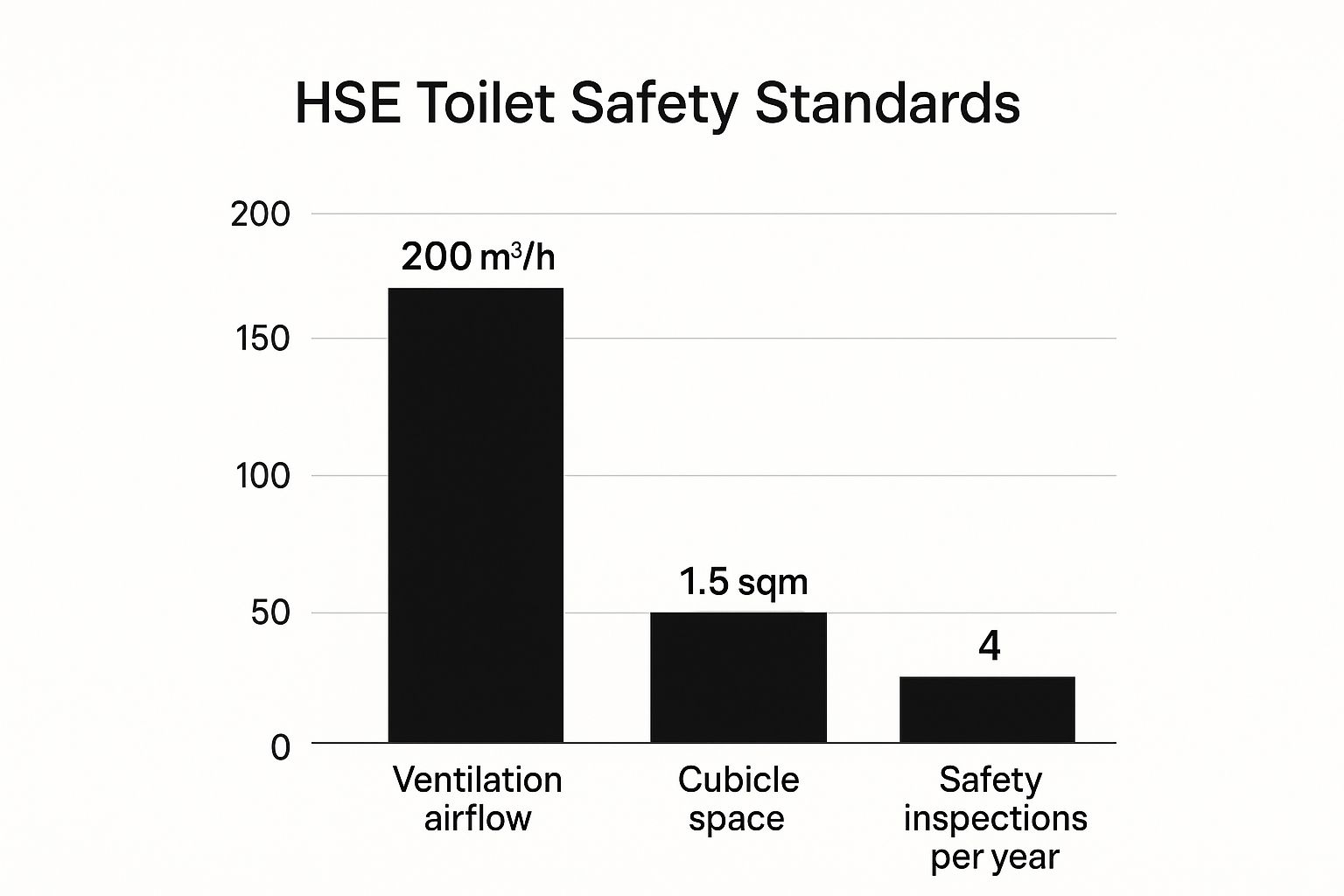
As you can see, it’s not just about the numbers. It’s about the quality and safety of the facilities you provide.
To make things crystal clear, here’s a quick guide based on the official recommendations.
HSE Recommended Toilet-To-Worker Ratios
Use this quick-reference guide to determine the minimum number of portable toilets required for your construction site, based on BS6465-1:2006 guidance.
| Number of Workers (per 40-hour week) | Minimum Toilets Required |
|---|---|
| 1 – 7 | 1 |
| 8 – 14 | 2 |
| 15 – 21 | 3 |
| 22 – 28 | 4 |
| 29 – 35 | 5 |
Remember, this is the minimum. If you have a large site with workers spread out, you might need more units to ensure easy access for everyone.
It’s More Than Just a Number
While the main Workplace (Health, Safety and Welfare) Regulations 1992 don’t technically apply to temporary construction sites, they’re the benchmark for what’s considered acceptable. The HSE uses this framework to decide if your site is up to scratch. The essentials are non-negotiable. You absolutely must have:
- Lockable Doors: Privacy isn’t a luxury; it’s a basic requirement.
- Lighting: Every unit must be properly lit, either by natural daylight or an internal light, so it can be used safely.
- Ventilation: Good airflow is key to keeping the loo hygienic and usable.
- Handwashing Facilities: This is a big one. You must provide sinks with running water, soap, and something to dry hands with.
A compliant toilet setup is a clear sign of a well-run, professional site. It tells inspectors, clients, and your own team that you do things properly.
Ultimately, the goal is to provide facilities that anyone can use hygienically and without a fuss. This includes making sure they are serviced regularly so they don’t get filthy or overflow. For a look at a unit that ticks all these boxes, check out our construction site toilet hire options, which are designed from the ground up to meet these strict HSE guidelines.

Essential Features Of A Compliant Toilet Unit
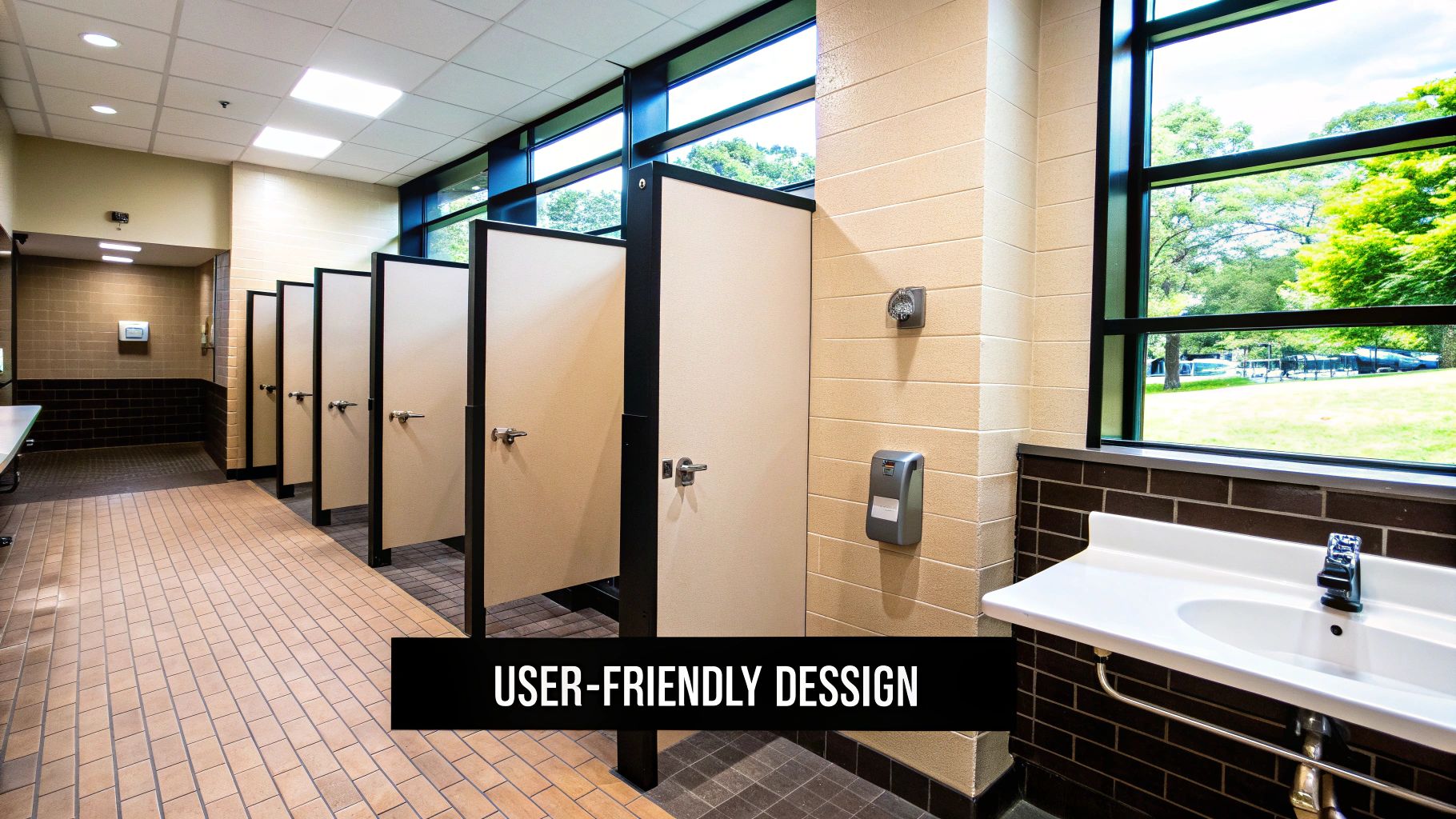
An HSE-compliant toilet is a world away from the basic plastic box you might see at a music festival. For a construction site, the rules are much stricter because these facilities are used daily by your team. Getting these details right is what keeps your site compliant and avoids any awkward conversations with an inspector.
It’s not just about having a loo; it’s about providing a complete, hygienic facility. The HSE looks closely at the specifics because they know proper handwashing is critical to stopping illness from spreading across a busy site. Let’s break down exactly what a compliant unit must have.
Handwashing Is The Deal-Breaker
This is the single biggest point of failure for many sites. Simply providing cold water from a small tank or, even worse, just a bottle of hand sanitiser, is not enough. The HSE is crystal clear on this.
To meet the standard, every single toilet unit must have proper handwashing facilities. This means:
- Running Water: A sink with a tap that provides a steady stream.
- Hot and Cold (or Warm) Water: This is non-negotiable. The water has to be at a suitable temperature for an effective wash.
- Soap: A dispenser with liquid soap, and it needs to be kept topped up.
- Hand Drying: You must provide a way to dry hands, usually disposable paper towels.
Forgetting even one of these four elements means your facility isn’t compliant. An HSE inspector will spot this immediately – it’s one of the first things they check.
Lighting And Ventilation
A dark, stuffy toilet isn’t just unpleasant; it’s a safety hazard. The HSE requires all welfare facilities to be safe and comfortable to use, whatever the time of day.
Good lighting is essential, whether it comes from a translucent roof letting in daylight or a dedicated internal light. It ensures your team can use the facilities safely without risking trips or falls, especially on dark winter mornings or if you’re running a late shift.
Ventilation is just as important. A well-ventilated unit stops unpleasant odours from building up and keeps the air fresh, which is a basic requirement for a hygienic space. Our HSE-compliant toilets are designed with integrated ventilation to make sure they always meet this standard.
The Compliance Checklist
When you’re hiring toilets or just checking your current ones, it pays to run through a quick checklist. Use these points to see if your site is up to scratch.
- Sufficient Numbers: Have you got at least one toilet for every seven workers?
- Lockable Door: Can the door be securely locked from the inside for privacy?
- Running Water: Is there a sink with a working tap?
- Correct Water Temperature: Does it provide hot/cold or warm water?
- Soap and Towels: Are soap and paper towels there and regularly restocked?
- Adequate Lighting: Is the unit well-lit for safe use at all times?
- Proper Ventilation: Does it have good airflow to prevent odours?
- Toilet Paper: Is it well-stocked with loo roll?
This simple audit can save you a lot of headaches. To see what a fully equipped unit looks like, check out these examples of our portable toilet hire for building sites and compare them to your current setup.

Your Servicing And Maintenance Responsibilities
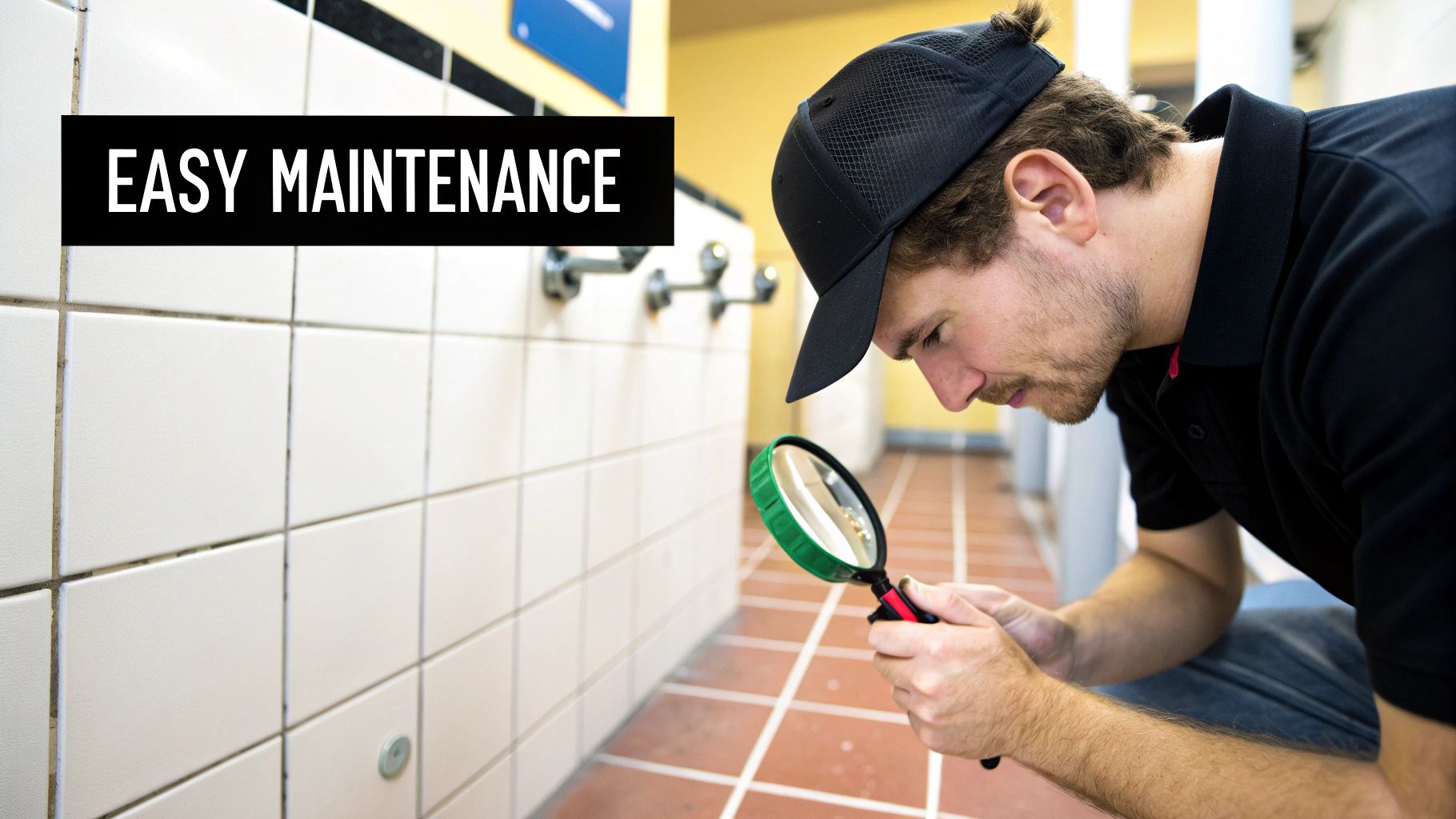
Getting a fully compliant toilet unit delivered to your site is a great start, but your legal duty of care doesn’t end when our truck pulls away. The HSE is just as focused on how you maintain your welfare facilities as they are on the initial setup. Regular, thorough servicing isn’t just a nice-to-have; it’s a core part of keeping your site legal and your team safe.
An overflowing, unstocked, or unhygienic loo is a massive red flag for an HSE inspector. It’s one of the most obvious signs that site management isn’t taking its responsibilities seriously. This is where a lot of contractors get caught out, facing penalties not for a lack of toilets, but for a complete failure to keep them in a usable state.
What A Proper Servicing Schedule Looks Like
So, what does “regularly serviced” actually mean? The industry standard, BS6465-1:2006, points to a minimum weekly service for a chemical toilet used by seven workers on a 40-hour week. Think of this as the absolute baseline. Any professional hire company, like Sarah’s Hire, will build this into your agreement from day one.
A standard service isn’t just a quick pump-out, either. It’s a proper clean that ensures the unit stays hygienic and fully functional. Here’s what’s included:
- Emptying and Recharging: We completely empty the waste tank and recharge it with the correct chemical solution to manage waste and odours.
- Deep Cleaning: The whole interior of the unit gets a thorough clean and sanitisation to kill germs and remove dirt.
- Restocking Consumables: We make sure it’s fully stocked with the essentials – toilet paper, soap, and paper towels.
- Inspection: A quick check is done to make sure the lock, sink, and tap are all working as they should.
This process is what keeps your HSE compliant toilets compliant for the entire hire period.
Adjusting The Schedule For Your Site
That weekly service is a starting point, not a hard-and-fast rule. As the site manager, it’s down to you to keep an eye on the facilities and bump up the servicing frequency if needed. The law is simple: you have to keep toilets clean and usable at all times.
You’ll need to think about a few things:
- High Usage: If you have more workers on-site, or you’re running double shifts, you will almost certainly need more frequent servicing.
- Hot Weather: Warmer temperatures can make chemicals less effective and increase odours. This often means you’ll need a twice-weekly service just to keep things acceptable.
A contractor in the Midlands recently got an improvement notice for this very reason. They had the right number of toilets and a weekly service plan, but a summer heatwave plus extra subcontractors meant the units were unusable by Wednesday. The HSE inspector pointed out that their failure to adapt the schedule was a direct breach of their duty of care.
This real-world example shows that compliance isn’t a “set it and forget it” task. It’s an ongoing process.
Why Choose Sarah’s Hire for Your Site Toilets?
When you need HSE compliant toilets on site, you can’t afford to mess about. You need a straightforward partner who gets the job done right, knows the rules inside out, and makes your life easier. That’s exactly what we do at Sarah’s Hire.
- Guaranteed Compliance, Every Time: Our promise is simple: every unit we deliver meets or exceeds HSE standards. You get fully equipped toilets with hot/cold running water, soap, and paper towels as standard, giving you complete peace of mind.
- Reliable Scheduled Servicing: A compliant toilet is only as good as its last clean. We agree a servicing schedule with you from day one and we stick to it, ensuring your facilities are always clean, stocked, and ready for your crew.
“Sarah’s Hire has been a game-changer for our sites in Worcestershire. The toilets are always clean, the service is reliable, and they just get on with it. It’s one less headache for me to worry about.” – Mark C., Site Manager
No fuss, no hidden fees—just the right equipment, delivered on time, every time. It’s that simple.
Get Your Site Welfare Sorted Today
Don’t let site welfare hold up your project or land you with a hefty fine. Getting your health and safety facilities right is non-negotiable, and our fully HSE-compliant toilets are the simplest way to tick that box. We handle everything from drop-off to scheduled servicing, leaving you free to focus on the job.
We deliver across the region, including:
- Worcestershire
- Gloucestershire
- Herefordshire
- Birmingham & The Midlands
Let us take the guesswork out of compliance.
Call us on 01905 358 695 or email info@sarahshire.com to discuss your needs and get your free, no-obligation quote today.
Frequently Asked Questions
We get a lot of calls from site managers wanting to get their welfare facilities spot on. Here are the straight answers to the most common questions we hear.
Do construction sites need separate toilets for men and women?
Ideally, the HSE would like to see separate facilities. But they’re realistic and know this isn’t always practical on smaller or temporary sites. So, unisex HSE compliant toilets are absolutely fine, as long as each toilet is in its own lockable room, ensuring total privacy for everyone on your crew.
What actually makes a toilet HSE compliant?
The main difference between a standard loo and a proper HSE compliant toilet for a building site is how you wash your hands. A compliant unit must have hot and cold (or warm) running water from a tap, plus soap and paper towels. A simple cold-water tap or a bottle of hand sanitiser just won’t cut it.
How often do my site toilets need servicing?
Legally, your toilets have to be kept clean and hygienic at all times. As a rule of thumb, the British Standard BS6465-1:2006 suggests a weekly service is the minimum for a toilet used by seven workers on a 40-hour week. But if you’ve got a bigger team or you’re running longer shifts, you’ll definitely need more frequent servicing to keep things up to standard.
Ready to make sure your site is fully compliant without the headache? The team at Sarahs Hire delivers reliable, HSE-compliant toilet hire with a servicing schedule you can set your watch by. Get your no-obligation quote today and let us handle the rest.