

Running a construction site means you’ve got a lot on your plate. From managing timelines and materials to keeping your crew safe, the last thing you need is a headache over welfare regulations. So, when it comes to the crucial question of how many toilets per employee UK law requires, you need a straight answer.
For a mixed-gender site, the rule is simple: one toilet for 1-5 employees, and two toilets for 6-25. But getting this right isn’t just about avoiding fines from the Health and Safety Executive (HSE)—it’s about showing your team you respect their basic needs. A muddy, poorly maintained site with long queues for the loo kills morale and slows down the job.
At Sarah’s Hire, we cut through the confusion. We provide builders and site managers like you with clean, fully compliant portable toilets, delivered on time, every time. This guide gives you the practical, no-nonsense advice you need to get your site welfare sorted, so you can focus on what you do best: building.
Your No-Nonsense Guide to Employee Toilet Rules
Providing the right toilet and washing facilities is a non-negotiable part of your legal duty as a site manager. But digging through official HSE regulations to find a simple number is a hassle you don’t have time for.
This guide is here to give you the facts. We’ll lay out the rules in a clear, practical way so you know exactly what you need to provide for your construction crew. No more second-guessing, just straightforward advice to keep your team happy and your site on the right side of the law.
Proper facilities are about more than just ticking a legal box; they’re fundamental to your team’s dignity and well-being. Think about the reality for your workers on the ground:
- Hard Graft: Your crew is putting in a physically demanding shift, often in muddy, challenging conditions. A clean, accessible toilet isn’t a luxury—it’s essential for their health and comfort.
- Morale and Productivity: No one should have to waste time trekking across a large site for a basic need. Having enough facilities close at hand keeps morale and productivity high.
- Respect: Providing decent welfare facilities shows you value your team. It’s a simple, powerful way to build a positive and respectful site culture.
“The toilets were spotless and the service was brilliant. Sarah’s Hire made sorting our site welfare so much easier and kept the lads happy.” – John P., Construction Site Manager, Brighton
John’s experience proves our point. A happy crew is a productive crew, and it all starts with getting the basics right. We make it simple for you to meet the regulations and properly support every member of your team.
How Many Toilets Do I Legally Need?
Let’s get straight to it. The number of toilets you need depends on the number of people on your site. The HSE provides clear minimum ratios to ensure everyone has reasonable access without long queues.
For mixed-gender (men and women) or female-only workplaces, the rules are simple and scale up with your team size.
Here’s a quick-reference table to help you find your number at a glance.
HSE Minimum Toilets for Mixed or Female-Only Staff
| Number of Employees | Minimum Toilets & Washbasins |
|---|---|
| 1-5 | 1 toilet & 1 washbasin |
| 6-25 | 2 toilets & 2 washbasins |
| 26-50 | 3 toilets & 3 washbasins |
| 51-75 | 4 toilets & 4 washbasins |
| 76-100 | 5 toilets & 5 washbasins |
It’s a straightforward system: for every 25 additional employees (or part thereof) over 100, you must provide one more toilet and washbasin. This ensures that as your workforce grows, your facilities grow with it.
What About Toilets for Men-Only Sites?
If you’re managing a site with only male employees—common in construction—the regulations are slightly different. The HSE allows for urinals to be used, which can change the calculation.
The key rule is that you still need enough facilities, but a urinal can replace a toilet. However, you can’t only provide urinals. There must always be at least as many toilets as there are urinals. In reality, it’s often simpler and better practice to just provide standard unisex toilet cubicles, which cover you for any situation.
A Quick Calculation Example
Let’s make this real. Imagine you’re a site manager for a construction project with 35 employees on site at any one time. Your team is a mix of men and women.
Looking at the table, your workforce of 35 falls into the “26-50” bracket.
- This means you are legally required to provide a minimum of 3 toilets and 3 washbasins.
It really is that simple. By hiring 3 standard portable toilets from us, each with its own hand washing facility, you’re fully compliant and have provided the necessary amenities for your team.
Understanding the Official UK Toilet Ratio Rules
When it comes to the official rules on how many toilets per employee UK law demands, everything circles back to The Workplace (Health, Safety and Welfare) Regulations 1992. This legislation created a single, nationwide standard for every employer, making life much simpler for builders and site managers trying to do the right thing.
Think of it as the bedrock of modern employee welfare. These aren’t just polite suggestions; they are legal duties you must fulfil to avoid serious penalties and to provide a decent, hygienic environment for your crew.
The Legal Framework Explained
At its heart, the legislation is all about providing “suitable and sufficient” facilities. What does that actually mean for you? It means you need enough toilets so your team isn’t stuck in long queues, and the facilities themselves must be clean, properly lit, and have decent ventilation.
For sites with mixed-gender or female-only staff, the rules are straightforward:
- 1 toilet and washbasin for 1–5 employees.
- 2 toilets and washbasins for 6–25 employees.
- 3 toilets for 26–50 employees.
This simple structure is designed to ensure that as your workforce grows, your welfare facilities scale up with it, maintaining good access and hygiene for everyone on site.
The regulations provide a baseline of dignity and hygiene. Failing to meet them isn’t just a compliance issue; it directly impacts your team’s health, morale, and productivity.
Practical Application for Your Construction Site
So, what does this all mean for you on the ground? Whether you’re breaking ground on a new housing development or managing a major refurbishment, these rules apply directly. You have a legal responsibility to count every single person working on your site—including your direct employees, temporary staff, and all subcontractors—and provide the correct number of toilets.
For most construction sites without permanent plumbing, portable toilets are the essential solution. When planning your project, you need to factor in hiring enough units to meet these legal standards from day one. Our guide to construction site portable toilets offers practical advice on choosing the right units for your project, making sure you stay compliant from the start.
Calculating Toilets for Male-Only Workforces
When your workforce is entirely male, which is common on construction sites, the rules on how many toilets per employee UK law requires change slightly. The Health and Safety Executive (HSE) guidelines recognise that for an all-male team, you can manage welfare facilities a bit differently by bringing urinals into the mix.
This isn’t about cutting corners; it’s a practical adjustment laid out in the British Standard BS6465-1:2006. It allows you to use your space and resources more effectively, especially on busy sites where long queues can slow things down.
The Urinal and Toilet Ratio
For washrooms used only by men, urinals can be used to supplement the number of toilets you provide. You can’t just install a row of urinals and call it a day. Enclosed toilet cubicles are still a must-have for privacy and proper hygiene.
- Critical Point: You must always provide the same number of washbasins as you do toilets. Urinals don’t count towards this washbasin calculation.
- The Golden Rule: You can never have fewer toilets than urinals.
This specific guidance for male-only facilities is a unique feature of UK workplace regulations. A small crew of up to 15 men needs just 1 toilet and 1 washbasin. But as your team grows to between 31-45 men, you’ll need 2 toilets, 2 washbasins, and 2 urinals. You can learn more by exploring the official washbasin and toilet ratio requirements.
The table below breaks down the HSE’s minimum requirements for male-only sites.
| Number of Male Employees | Minimum Toilets Required | Minimum Urinals Required | Minimum Washbasins Required |
|---|---|---|---|
| 1 to 15 | 1 | 0 | 1 |
| 16 to 30 | 2 | 1 | 2 |
| 31 to 45 | 2 | 2 | 2 |
| 46 to 60 | 3 | 2 | 3 |
| 61 to 75 | 3 | 3 | 3 |
| 76 to 90 | 4 | 3 | 4 |
| 91 to 100 | 4 | 4 | 4 |
This setup provides a practical way to manage facilities on a busy site without compromising on welfare standards.
Planning for Your Male Workforce
To give you a quick visual guide, this chart shows how the requirements scale up.
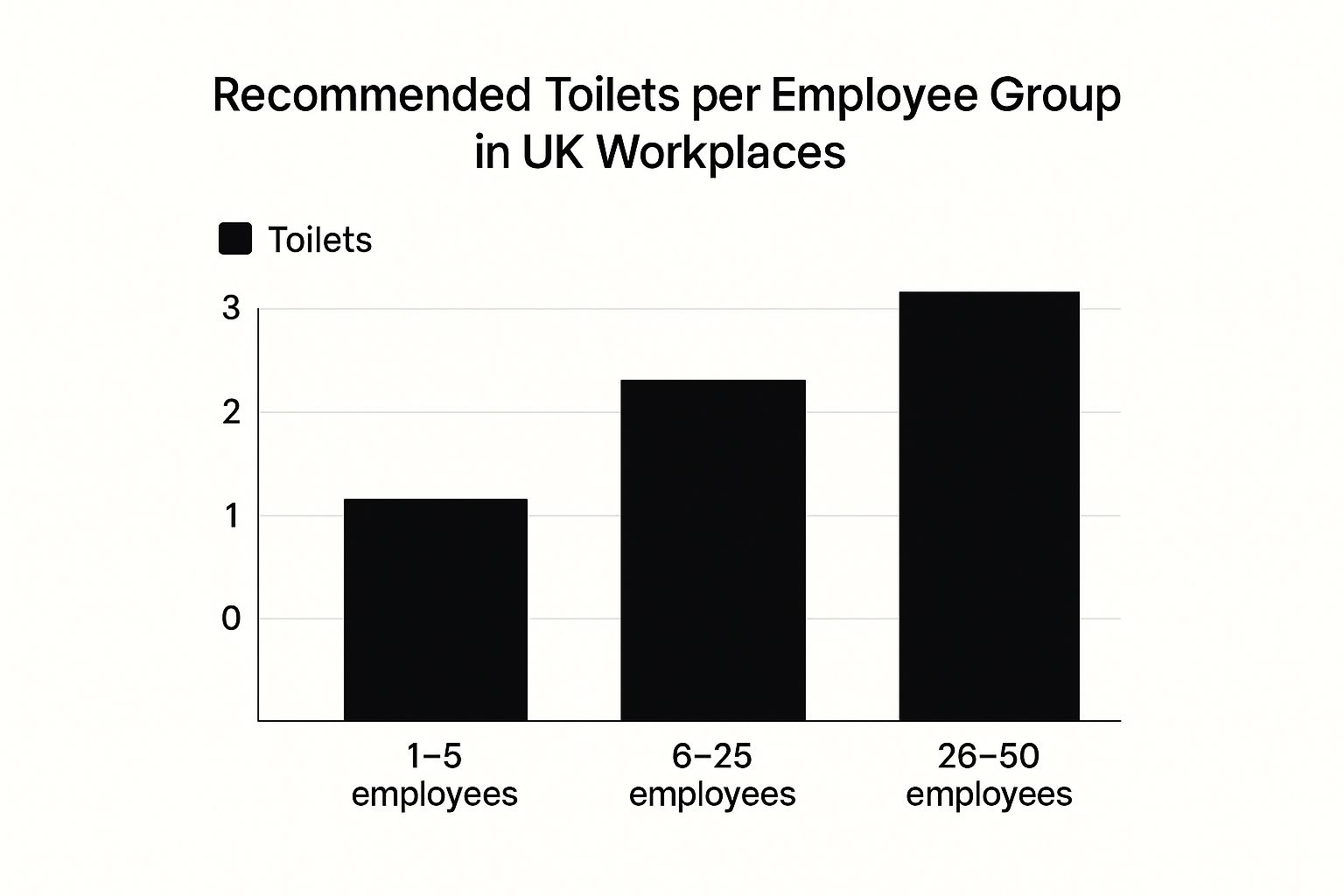
The infographic gives a great baseline for mixed or female-only sites and shows just how crucial it is to increase your toilet count as the team expands.
Getting this right isn’t just about ticking a compliance box. It’s a practical solution for busy, male-dominated sites that keeps your team happy and your project running smoothly.
Essential Provisions Beyond the Toilet Count
Hitting the right numbers for how many toilets per employee UK regulations require is the starting point, not the finish line. To be genuinely compliant with HSE guidelines, your welfare facilities must be suitable for your team. And that involves much more than just a headcount.
A car needs more than just an engine; it needs clean fuel and oil. In the same way, your site toilets need to be clean, well-maintained, and properly stocked to pass muster. It’s these practical details that turn a simple loo into a compliant and functional facility.
What Makes a Toilet Facility “Suitable”?
The HSE uses the phrase “suitable and sufficient” for a reason. It means your facilities have to be fit for purpose. Here’s what you absolutely must provide:
- Running Water: Hot and cold running water for proper hand washing.
- Essential Supplies: Soap or other suitable cleaning agents.
- Hand Drying: Paper towels or a hand dryer.
- Lighting and Ventilation: Well-lit for safety and properly ventilated.
These are the non-negotiables. Our portable toilets are delivered fully equipped with all these essentials, getting you compliant the moment they arrive. For larger jobs, our construction site welfare units provide a more robust, all-in-one setup.
Keeping facilities stocked and clean isn’t just about ticking a box. It’s about basic human dignity. A well-cared-for toilet shows your team you value their well-being, which goes a long way in building morale on site.
Health, Safety, and Training
A safe working environment isn’t just about the physical setup; it’s also about knowledge. For instance, another crucial part of employee welfare is providing comprehensive bloodborne pathogens training for staff who might be exposed to hazardous materials. This is especially relevant in any setting where injuries could happen, as it ensures everyone knows how to handle the situation safely and hygienically.
Why Choose Sarah’s Hire?
When you’re running a busy site, you need a supplier that solves problems, not creates them. You don’t have time to become an expert on the HSE rulebook. That’s our job.
We deliver clean, modern, and fully-stocked portable toilets that tick every box for legal requirements. Our entire service is built around being prompt, friendly, and completely reliable, leaving you free to focus on the job at hand.
For more complex sites that need more than just toilets, our welfare unit van hire guide breaks down everything you need to know about all-in-one solutions.
Areas We Cover
Our team is on the road every day, delivering essential site facilities to builders and construction managers across the South East. No matter where your site is, you get the same high standard of service.
We cover:
- Sussex
- Surrey
- Kent
- Hampshire
- London
From a major development in London to a small build in the Sussex countryside, we’ve got your welfare needs sorted.
Why Choose Sarah’s Hire
- Guaranteed Compliance: Forget the guesswork. Our units are fully compliant with all UK regulations, so you’re covered from day one.
- On-Time, Every Time: We know delays cost money. We guarantee on-time delivery and collection to fit your project schedule.
- Spotlessly Clean: A clean site is a happy site. Every toilet is deep-cleaned and fully stocked before it reaches you. Your crew deserves decent facilities, and we deliver them.
Get Your Site Compliant Today

Ready to get your site welfare sorted? Don’t let something as simple as toilet hire lead to fines or project delays. We provide the clean, reliable, and fully compliant portable toilets you need to keep your site running smoothly.
Our friendly team is on hand to help you calculate your requirements and schedule a delivery that works for you. Let us take the guesswork out of site welfare—it’s what we do best.
Get in touch today for a straightforward, no-obligation quote.
Call us on: 01403 253335
Email us at: info@sarahshire.co.uk
FAQs for Builders & Site Managers
Still have questions about toilet regulations for your construction site? Here are the straight answers to the common queries we get from managers like you.
Do Temporary Workers and Subcontractors Count?
Yes, absolutely. The HSE regulations cover everyone working on your site. When you’re calculating how many toilets per employee UK rules require, you must count your direct staff, agency workers, and all subcontractors. It’s about the total number of people on site at any one time.
What if My Site Has No Mains Water or Drainage?
This is the standard situation for most new builds and remote construction projects. It’s no problem at all. Our self-contained portable toilets are the perfect, HSE-approved solution. They don’t need any connection to mains water or sewerage. Each unit has its own water supply for hand washing, making them a practical and compliant choice for any location.
How Often Should Site Toilets Be Cleaned and Serviced?
The official rule is that facilities must be kept in a “clean and orderly condition.” In practice, this means they need regular, professional servicing. When you hire from us, a scheduled cleaning and restocking plan is a core part of the service. We’ll work with you to set a service frequency based on your crew size and project length, ensuring your toilets stay hygienic from start to finish.